NNick

Content studio

Make it in Post Lab, star the keepers, add them to the calendar, push to Postiz. Sep 23 to Jan 8.

The Redwater Brief · Friday, Sep 25

The AI products got a storefront. The rules still have no referee.

Anthropic opened Claude Marketplace on Sep 23, one page for connectors, Claude-powered agents and consulting partners, and took Claude Code's cloud sessions out of preview the same day. Meta put its Muse agent at the center of every device it showed at Connect without saying how many people use it. Pope Leo XIV told scientists that no technology is neutral and opened his France trip warning of a "paradise of machines", while at the UN the US rejected global AI governance as a group of Western leaders designs a nuclear-style oversight body.

Covers Sep 23 to 25, 2026

Accounts watched
Read
243 posts · 1 episodes
Stories
4
Ideas
4 0 in Post Lab
X posts · ApifyStacked transcripts · yt-dlpPrimary sources · webSorted and written · Sonnet 5Matched to your banks · Opus 5.5
01

The five that matter

Each story is its own briefing: what happened, what changed, who it touches and what it means for us. A story that continues an earlier brief says so and leads with what is new. Present opens any story full screen; Backdrop downloads the art.

Ranked on four scores, 1 to 5:Owner impact changes what a local owner can do, pay or expect within 90 daysOur work changes what we build, sell or sayContent fuel has an angle plus proof in our banksConfidence verified at a primary sourceTies are broken by Our work.
AI & Claude · Product launchDeveloping · since Sep 16Backdrop
01

Claude Marketplace launches as Claude Code cloud sessions leave research preview

Anthropic opened Claude Marketplace on Sep 23, one page for connectors, Claude-powered agents and consulting partners, and the same day moved Claude Code's cloud sessions out of research preview for Pro, Max, Team and Enterprise premium seats, with a one-time credit for existing subscribers.

New since Sep 21

Anthropic gave the merged Claude a public storefront, Claude Marketplace, for the connectors, agents and consulting partners that plug into it. The same day, Claude Code's cloud sessions left research preview and Projects gained local support, so the threads that used to run only in Anthropic's cloud can now run on a person's own machine too.

What happened

Anthropic opened Claude Marketplace on Sep 23 at claude.com/marketplace, a single page for three things that used to live apart: more than 2,000 connectors and plugins, including Atlassian, Google, Microsoft, Notion and Salesforce; Claude-powered agents and products from companies such as Cursor, CrowdStrike, Harvey, Legora, Lovable and Snowflake; and consulting and integration work through the Claude Partner Network, which named Accenture, Boston Consulting Group and Deloitte as launch partners. Anthropic said customers with an existing committed Anthropic contract can put a portion of that spend toward the agent and product purchases; its own marketplace page directs those customers to their Anthropic account team to start buying, and does not state what portion of a commitment can be applied. Companies can apply to list a connector, built on the Model Context Protocol and Agent Skills, or a Claude-powered product, and services firms apply through a partner waitlist to join the Claude Partner Network, which Anthropic describes as built for the security, scale and compliance needs of enterprise customers.

The same day, Anthropic said cloud sessions, the feature previously called Claude Code on the web that keeps Claude Code working on Anthropic's own servers after a laptop closes, left research preview and became generally available for Pro, Max and Team users, and for Enterprise users with premium or Chat + Claude Code seats. Existing subscribers get a one-time credit to try it, $100 on Pro and $250 on Max, spent before normal plan usage. Anthropic also added local support to Projects, the feature that splits one conversation into parallel threads: those threads had run only as cloud sessions since Projects launched Sep 17, and can now run on a person's own machine instead.

Before

Chat and Cowork had merged into one Claude with documents, slides and design inside the conversation, Projects could split a conversation into parallel cloud threads, and Claude Code could read a repo's AGENTS.md file. Nothing yet gathered the tools, agents and outside partners that connect to any of it in one place, and Projects only ran in Anthropic's cloud.

Now

Every connector, Claude-powered product and consulting partner has one page to be found on, cloud sessions are a stable plan feature instead of a preview, and Projects can run on a person's own machine as well as in the cloud.

Who it touches
  • Owners already paying for Claude Pro or Max, who can now browse and add connectors from one page and get a one-time credit, $100 on Pro or $250 on Max, to try cloud sessions.
  • Enterprise customers with an existing committed Anthropic contract, the only buyers Anthropic's own marketplace page currently routes to an account team for agent and product purchases.
  • Software companies named at launch, such as Cursor, CrowdStrike, Harvey, Legora, Lovable and Snowflake, who now sell through one Claude storefront instead of separate deals.
  • Consulting and systems-integration firms at the scale of the launch partners, Accenture, Boston Consulting Group and Deloitte, which Anthropic's partner waitlist page says it is building for the security, scale and compliance needs of enterprise customers.
What it means for the business

We already do the kind of connector work the Marketplace now catalogs, wiring Claude into the calendars, sheets and CRMs an owner already runs. A named, public home for that category is useful in a sales conversation because it is easier to point at than to explain from scratch. The pages do not say whether a shop our size can list there: the partner waitlist is written for enterprise-scale firms like Accenture and Deloitte, so we are not claiming a spot.

Cloud sessions and local Projects both reaching general availability on the same day is closer to home. It is the same choice we make on every build, whether a job runs on someone else's server or the owner's own machine, and Anthropic is now offering both as finished options instead of one preview feature.
Church & Tech · Papal teachingDeveloping · since Sep 19Backdrop
02

Pope Leo XIV warns of a 'paradise of machines' opening his France trip

On Sep 24 Pope Leo XIV told the Pontifical Academy of Sciences that every technology reflects a view of the human person. He opened a four-day trip to France on Sep 25 by warning French leaders at the Élysée Palace that AI risks a 'paradise of machines' without an urgent turn to ethical discernment.

New since Sep 22

Pope Leo XIV spoke on technology himself for the first time in this thread, twice in two days: telling the Pontifical Academy of Sciences on Sep 24 that no technology is neutral, then opening a four-day trip to France on Sep 25 by warning that AI risks a 'paradise of machines' without an urgent turn to ethical discernment.

What happened

On Sep 24, Pope Leo XIV received the plenary assembly of the Pontifical Academy of Sciences in the Vatican's Clementine Hall, about 140 members meeting on the theme "The Future of Science in a Changing World." He told them that technological progress is never simply a technical matter, and that every technology reflects, whether explicitly or implicitly, a particular understanding of the human person, of society and of the future we wish to build. He named artificial intelligence directly, pointing to its potential in medicine, food production and knowledge of the universe alongside its uncertain impact on humanity's future and its use for surveillance, manipulation and discrimination. He asked the scientists for a growth in responsibility to match the growth in power: the greater the capacity to transform the world, he said, the greater the duty to discern what serves human dignity and to govern wisely.

The next morning, Sep 25, the Pope left Rome to open a four-day trip to France, his fifth international journey, with stops planned in Paris, Lourdes and Metz. After landing at Paris-Orly and being received by President Emmanuel Macron, he addressed French political, cultural and diplomatic leaders at the Élysée Palace and returned to the same theme in sharper language: if humanity is to avoid losing itself amid a "paradise of machines" invading and conditioning daily life, he said, there is an urgent need for education in ethical discernment and the capacity to recognize the moral good.

Before

The most recent word from Rome in this thread was Bishop Cantú describing a US bishops' task force at odds with the White House; the Pope's own most recent public words on AI were from the Lateran conference four days earlier.

Now

The Pope has now spoken twice himself in two days, in two different rooms: telling scientists in the Vatican that no technology is neutral, then telling French leaders that AI risks a "paradise of machines" without an urgent turn to ethical discernment.

Who it touches
  • Catholics in business who look to Rome for how to weigh a new tool, not only whether it works.
  • Scientists and researchers, since the Pontifical Academy's own members got the same responsibility standard applied to their work.
  • European policymakers and diplomats, since the Pope delivered this from inside the Élysée Palace itself.
  • Anyone who fields the moral objection to AI in a room, who now has two fresh, exact quotes from the Pope.
What it means for the business

The Pope's framing gives a plain-language test to hand an owner who is wary of AI without being against it: does this technology reflect a decision that serves the people it touches, or only the convenience of the person running it. That is close to the same access-and-approval conversation we already have on every build, now said from outside the industry twice in two days.

The "paradise of machines" line is also a useful caution against automating for its own sake. The systems we build exist to give an owner back hours, not to run the business without the owner in it, and a warning against invisible automation that conditions daily life backs up why a human stays in the loop on anything touching money or a customer.

AI & Tech · Product launchDeveloping · since Sep 22Backdrop
03

Meta expands Muse into a VR headset, a Mac and a new pocket device

At its Sep 23 Connect keynote, Meta said Muse is coming to Mac computers now, to its camera glasses in the coming months, and to a new $1,299 VR headset in spring 2027, plus a pocket-sized Muse Charm device shipping in December. Meta did not disclose how many people use Muse or how often.

New since Sep 22

Meta's Sep 23 Connect keynote made Muse the center of every device it showed: a $1,299 VR headset with Muse in the operating system, a pocket-sized Muse Charm shipping in December, computer control on a Mac, a promised email address for the agent, and a promise to reach Meta's camera glasses within coming months. Meta gave no usage or daily-use number for Muse anywhere in the keynote.

What happened

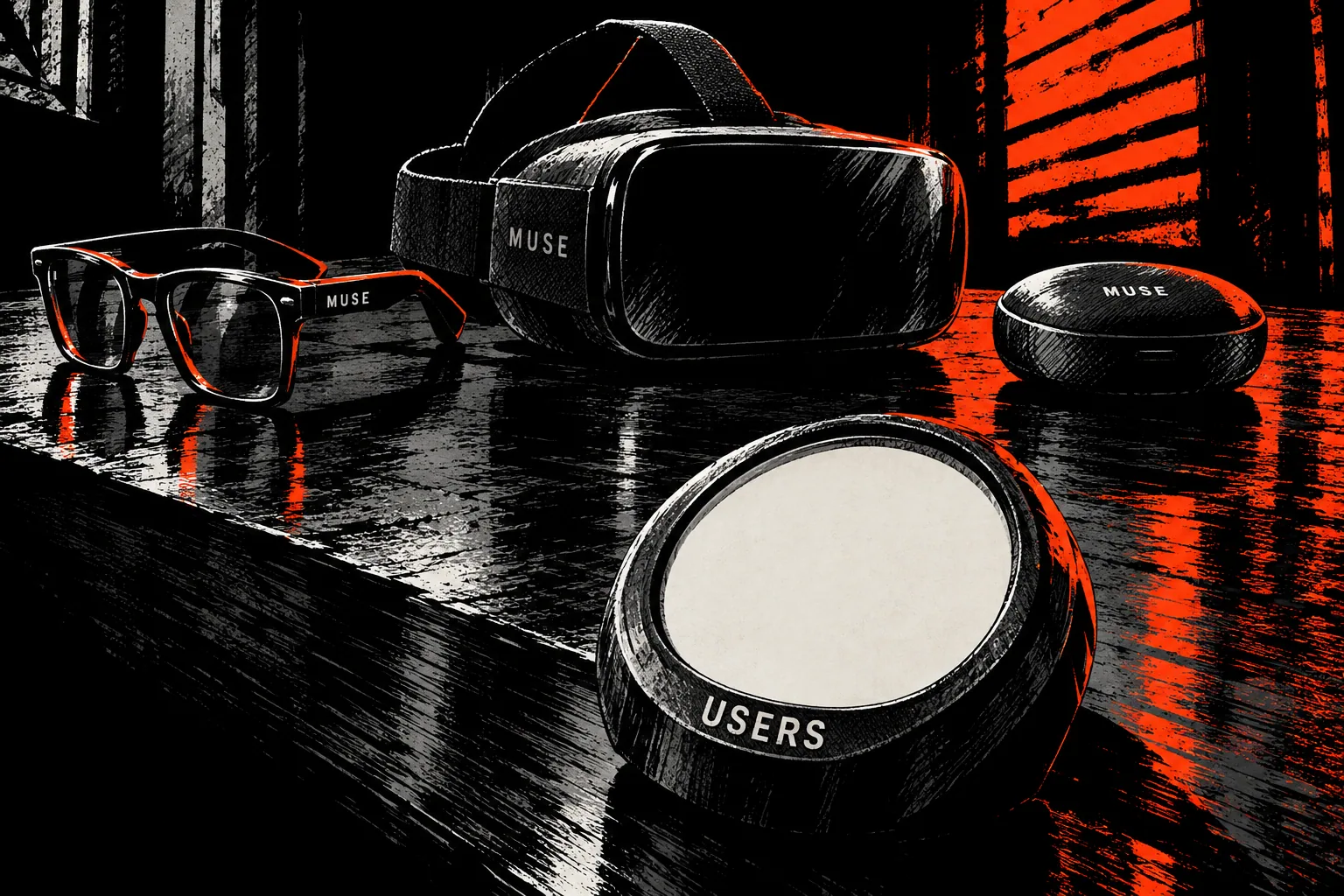
Mark Zuckerberg's keynote at Meta's Connect conference, at 4 p.m. Pacific on Sep 23, put Muse at the center of every product Meta showed. Muse can now drive any application on a Mac with a person's permission, a feature Meta calls computer use, and Meta said it will get its own email address that a person can copy on a thread or forward a message to for the agent to handle. Meta also showed a video version of the agent, a Muse Realtime Avatar named Jolly, and let users customize its voice by describing an accent, a speed or a personality. Two new pieces of hardware carry Muse further: a $1,299 headset called Meta VR Glasses, shipping spring 2027 with Muse built into the device's operating system and controlled by hand and eye tracking, and Muse Charm, a pocket-sized device for talking to Muse that Zuckerberg said on Sep 23 ships in December; Meta has not given its price or full specifications. Meta also said Muse is coming to its camera-equipped Ray-Ban Meta glasses within coming months, with a customizable wake word replacing 'Hey Meta' and the ability to act on what the wearer is looking at without being told. Muse's shopping connectors grew to include Walmart, Best Buy, Sephora and Wayfair, with PayPal and Shop Pay for payment and Instacart for groceries. Two new glasses arrived sooner: Ray-Ban Meta Gen 3 at $449, available the same day, and a camera-free Ray-Ban Meta Audio at $349 on Oct 13.

None of it came with a number. Meta's own newsroom recap of the keynote listed dates and prices for six pieces of hardware and did not once state a user count, a daily-use figure, or how many of Muse's downloads had turned into a second or third session. Before the keynote, Deepwater Asset Management's Gene Munster said he expected Meta shares to move little on it, because he expected no real numbers on how many people use Muse day to day; Meta shares slipped in after-hours trading once the keynote ended.

Before

Muse was a two-week-old phone and web app, known mainly for topping the App Store and for a stock jump built on an app-store rank and a price target, not on any number from Meta itself.

Now

Muse is Meta's answer for a Mac, a headset, three lines of glasses and a new pocket device, and Meta still has not said how many people use it or how often.

Who it touches
  • Owners whose staff already carry Muse on a personal phone, now that it can also drive a work Mac, with its own email address on the way.
  • Shoppers who buy through Meta's apps, now that Muse's commerce connectors reach Walmart, Best Buy, Sephora and Instacart.
  • Anyone buying smart glasses or a VR headset in the next year, the market Meta just built three new devices for.
  • Investors and analysts, who got dates and prices for six devices before they got a single usage number.
What it means for the business

The Sep 22 pitch point holds and gets a second example. An agent that can now drive a Mac, and will soon have its own email address, needs the same access-and-record answer a business system gives, not a personal agent's answer. A client asking what is different about a built system now has computer use, and soon an agent's own email address, to compare against, on top of the phone and calendar access already in the pitch.

It is also a caution worth keeping for our own updates. Meta shipped a full hardware line and said nothing about who uses it or how much, and analysts covering the keynote noticed the gap. Any update we send a client is worth pairing with a real number on what changed, not just the news that something shipped.

AI & Society · PolicyDeveloping · since Sep 16Backdrop
04

A coalition of Western leaders pushes global AI rules the US has rejected

At the UN Security Council on Sep 23, the Chinese labs invited to brief alongside Anthropic and OpenAI did not speak, and the US told the Council that global AI governance was off the table. The next day, the Wall Street Journal reported that Canada's Mark Carney, France's Emmanuel Macron, Norway's Jonas Gahr Store and Finland's Alexander Stubb are coordinating a global AI oversight body modeled on nuclear-era treaties.

New since Sep 23

The Security Council session happened on Sep 23, but DeepSeek and Moonshot, the Chinese labs invited to brief alongside the American ones, did not speak, and the US delegate told the Council that global AI governance was off the table. A day later, the Wall Street Journal reported that a club of Western heads of state and government, including Canada's Mark Carney and France's Emmanuel Macron, are coordinating a specific proposal for a global AI oversight body, comparing it to the nuclear arms treaties of the early Atomic Era.

What happened

The Security Council held its high-level session on AI and international security on Sep 23, chaired by France's Jean-Noel Barrot. Yoshua Bengio, Sam Altman, Dario Amodei and Hugging Face's Clement Delangue briefed the Council, warning that frontier AI could soon act beyond human control. DeepSeek and Moonshot, the Chinese labs publicly invited to speak alongside them, are not listed among the briefers in the UN's own meeting record, and no Chinese lab representative addressed the Council. The US delegate, White House science adviser Michael Kratsios, told the Council that "international dialogue cannot drift towards global governance" and rejected what he called "any attempt to construct a globalist scheme of control." The UK, France, Denmark and Pakistan called for a shared framework and guardrails on military use; Russia questioned whether AI belonged on the Council's agenda; and China's delegate touted its own AI-training offer to developing countries rather than joining a Western framework. The session produced no resolution or binding decision.

A day later, the Wall Street Journal reported that a club of Western heads of state and government, including Carney, Macron, Norway's Jonas Gahr Store and Finland's Alexander Stubb, are coordinating privately on a specific proposal: a global body to oversee frontier AI models, which the paper compared to the nuclear arms treaties that took root in the early Atomic Era. Stubb has said his preference is a body modeled on the International Atomic Energy Agency, working inside the UN; Carney has called separately for a "technology stability board" modeled on the Financial Stability Board. Stubb and Store's declaration that AI "must remain under human direction, oversight and control" has been joined by 22 leaders from 20 countries, including Germany, Canada, the Netherlands and Australia, but not the United States or China.

Before

Western leaders had made individual, scattered calls for global AI rules, and the Security Council session was scheduled with Chinese labs expected to brief for the first time alongside the American ones.

Now

The session ran without a Chinese lab briefing and the US told the Council it opposes global AI governance. Four Western leaders are now designing a nuclear-style oversight body, and 22 leaders from 20 countries have signed a declaration that AI must stay under human control; neither the US nor China is among them.

Who it touches
  • The 22 leaders from 20 countries who have signed Finland and Norway's declaration that AI must remain under human direction, oversight and control.
  • The White House, which told the Security Council that international AI governance is off the table.
  • OpenAI, Anthropic and Hugging Face, which briefed the Council but received no commitment from any government.
  • Owners weighing whether AI rules will eventually reach the tools they buy, though nothing here changes that this year.
What it means for the business

Nothing here changes what an owner can do with AI this quarter. This is a fight between governments, not a rule reaching a small business's tools. What it gives us is a sharper answer to the "won't this get regulated" question we sometimes hear on calls: not one law, but a proposed international watchdog, modeled on the nuclear-era IAEA, that a group of Western leaders is actively designing while the US government has said in public, at the UN itself, that it wants no part of it.

The practical answer for owners stays what it has been all thread: there is nothing to wait for. If a global AI treaty is ever signed, it will govern the labs building the frontier models, not the tools an owner already uses day to day.

02

By beat

Everything else worth knowing this week, grouped by beat, each with a link to the original.

Most relevant first
AnthropicSep 24

Anthropic resumes billing for blocked requests in three high-risk categories

Anthropic said it will again charge for requests its safety classifiers block before Claude responds, but only in categories with low false-positive rates: biology, distillation attacks (called "reasoning extraction" in the API) and frontier LLM development, after what it called coordinated attacks on its systems. It says 99.7% of accounts on Claude Code, claude.ai or Cowork never hit one of these blocks, and the classifiers behind them are tuned to a false-positive rate under 0.1%.

AnthropicSep 23

Global health groups use Claude in the response to an Ebola variant in DR Congo

CEPI, the WHO's Africa office and Congo's INRB lab are using Claude in the response to a Bundibugyo ebolavirus outbreak with no approved vaccine, at 7,672 confirmed cases and a 48.2% fatality rate as of Sep 19. WHO Africa built a Claude skill that cuts its daily situation report from a full day to under an hour, CEPI uses it to compare vaccine proposals, and Claude processes viral genome sequencing at INRB to track how the variant is spreading.

OpenAISep 23

OpenAI releases MentalHealthBench, built with more than 80 clinicians

The open benchmark pairs 1,215 synthetic mental-health conversations with 5,262 rubric criteria co-written by more than 80 psychologists and psychiatrists across 22 countries. It scores whether a model gives clinically accurate answers, recognizes urgency and preserves a user's agency, and OpenAI released it publicly so other labs can run their own evaluations.

AnthropicSep 23

Anthropic publishes the actual prompts it used to make claude.ai 3x faster

A two-week sprint using Claude itself to measure, debug and improve performance cut the time to a typeable page on a fresh claude.ai load from 3.1 seconds to 0.55 at the 75th percentile, and Anthropic says it merged more than three thousand changes with no customer-facing incident. The post includes the prompts and methods behind the work, not just the results.

Claude Code teamSep 24

Plan mode's fate: folded into a mod, not removed

Updating a Sep 23 post that floated removing plan mode, Anthropic's Thariq said the actual plan is to turn plan mode into a built-in mod and let other mods add new modes or override the shift+tab hotkey, after feedback that some people rely on its UX for thinking out loud with Claude.

Prix Goncourt / France 24Sep 25

France's top literary prize drops a novel over AI-writing accusations

The Prix Goncourt academy removed Thelyson Orelien's debut novel, which had sold 35,000 copies in five weeks, from its longlist after online claims and its own findings that the book was, in its words, very largely the product of artificial intelligence. Orelien denies it, telling French media he has always loved writing and sees no reason he would use a machine, and says he is assembling proof for his publisher.

AnthropicSep 23

Claude flags a previously unknown enzyme system in bacteriophage DNA, next to a CRISPR-like repeat array

About 950 Claude agents spent 21 hours searching roughly 1.9 billion protein clusters and flagged a reverse transcriptase sitting beside a long array of evenly spaced DNA repeats, a layout Anthropic compares to CRISPR's array of guide RNAs. The reverse transcriptase itself was already known; Anthropic says what is new is spotting the repeat array and a second, unexplained gene next to it, and it does not yet know what the combined system, which it calls ART, does. CRISPR pioneer Feng Zhang called the find "genuinely intriguing" and said it "merits further investigation," while Dimitri Perrin, head of the School of Computer Science at Queensland University of Technology, told Gizmodo: "ART is CRISPR-like in its architecture, but there is no evidence that it is CRISPR-like in its function."

04

Content wellspring

Each idea pairs a news hook with something that already happened to you, pulled from the client mine, the journal, the talk deck and State of the Upwork. Ideas stay here until you send one to Post Lab. Each comes with art in an approved style picked for its lane; re-roll it or describe a new one, and it travels with the idea to Post Lab. Ideas sparked by a podcast say so.

Whiteboard marker sketch
Case study · cardnfbnignlicfbcig

The quote that fell between the invoicing app and the calendar

The hook
Claude Marketplace launched Sep 23: a business can add connectors and plugins such as Slack and Notion, and buy agents and products from other companies.
From your bank
a customer might call us and say, hey, 2 months ago, y'all came out and did a quote, and I never heard back.
client-mine676fe12fbd18
Your angle. An electrical shop ran its money in QuickBooks and its crew's day in Google Calendar. A quote that was written but never answered lived in neither app, so nothing reminded anyone. Every once in a while a customer would call to say they got a quote two months ago and never heard back. Wiring those two apps together would not have caught it, because neither one was holding the quote. The fix was a step, not a link: every call becomes a ticket, and a ticket with no quote sits under New Call until someone writes one. Before you add a connector, find the job in your week that no app is holding.
intel-2026-09-25-daily-01
Thermal receipt
Case study · cardnfbnignlicfbcig

One YouTube comment. A day later, an AI email showed up.

The hook
An Anthropic engineer's rule for sharing anything Claude writes, messages included: share it only if you would be happy sharing the prompts too.
From your bank
About a day later, a pretty rough AI slop email hit my account.
skool-mineswipe-file #69
Your angle. I left a comment on a YouTube video, and about a day later an email landed. It looked like an automation had gone through the comments, picked out people with their own channels, found an email address and sent each one a custom note. It was rough, and it read like a machine wrote it. Nobody would have been proud to show me the prompt behind it, and that is the whole test. An agent that sends email for you just topped the iPhone chart, so before one writes to your customers, read five of its emails the way a customer would, and only send what you would be fine with them seeing the prompt for.
intel-2026-09-25-daily-02
Duotone halftone (black + red-orange)
Failure · textnfbnlicfb

Our group AI class overwhelmed them. One desk at a time worked.

The hook
Claude Marketplace launched Sep 23 with connectors, agents from other companies and, on the same shelf, service partners such as Accenture and Deloitte.
From your bank
Instead of group classes on Claude (they were overwhelmed) I’m gonna go in one office at a time and set them up myself.
skool-mineswipe-file #37
Your angle. In July we tried teaching an office to use Claude as a group class. The first session went to downloads and logins, and they were overwhelmed. They asked for one-on-ones instead, so I sat at each person's desk, set it up on their own computer around their own emails and reports, and let them watch me do it. They liked it far more than the workshop. The lab's new store puts the people who help you set up on the same shelf as the tools, which is the same lesson from the other end: getting access is easy, and setup is where people stall. If you're bringing AI into your office, skip the class. Start at one desk, with the one job that person repeats most.
intel-2026-09-25-daily-03
The change should land on the office, not the crew in the vansType card
Type card · no generated art on faith topics
Worldview · textnfbnli

The change should land on the office, not the crew in the vans

The hook
Pope Leo XIV to the Pontifical Academy of Sciences, Sep 24: "Every technology reflects, whether explicitly or implicitly, a particular understanding of the human person, of society and of the future we wish to build."
From your bank
What I want for them is for them to not really experience a huge change.
client-minebedb4698150c
Your angle. Walking through the new system for the first time, an electrical shop owner drew the line: almost nothing should change for the techs, and everything should change for the two people running the office. The people who chose the tool carry the change, and the crew in the vans keeps its routine. That is an understanding of the person built into software. In the same talk the Pope asked us to "care for those who may bear the greatest consequences of our choices," and when a shop brings in AI, that is usually the crew. Before you buy, ask who carries the change, and make sure it isn't the person with the least say in it.
intel-2026-09-25-daily-04
05

Quotes worth saving

Exact wording only, always linked. Good for slides, captions and talks.

"Technological progress is never simply a technical matter."
Pope Leo XIV, address to the Pontifical Academy of Sciences · Sep 24, 2026Read ↗
"The more time I spend working with coding agents, the more convinced I am that they make software engineering even harder"
Simon Willison · Sep 25, 2026@simonw
"my rule for sharing Claude output (PRs, artifacts, messages) is that I only do it if I would be happy sharing the prompts"
Thariq, Claude Code team at Anthropic · Sep 24, 2026@trq212
"It is extremely clear at this point in AI development that, regardless of risk or revenue or any of the other stuff discussed on X all the time, things are just going to keep getting weirder."
Ethan Mollick · Sep 25, 2026@emollick
"I've always loved creating and writing, I don't see why I would use a machine"
Thelyson Orelien, denying his novel was AI-written · Sep 25, 2026Read ↗
06

Coming up

Dates worth planning content around.

Oct 13-15TechCrunch Disrupt 2026 in San Francisco, where Anthropic and OpenAI join the AI stage.AI & Claude
Oct 20Ethan Mollick's new book Co-Existence, on living and working with AI systems that are sometimes smarter than we are, publishes.AI & Claude
Dec 2The EU AI Act's next compliance deadline takes effect, banning AI tools built for non-consensual intimate image generation and AI-generated child sexual abuse material.AI & Claude
07

Sources

What this brief watched and what it cited. Posts and podcasts are leads; every fact in a top story was checked at the sources listed under it.

X accounts watched48
Podcasts1 episode

Read for takes and leads only. A podcast claim never stands as a source on its own.

Data1

Our monthly report on the Upwork automation market. Read-only from its database.

Cited in the top stories18 links
Linked from the beat cards9 cards
Daily brief · Friday, Sep 25 · built Sep 25, 9:18 AM by /intel-brief · covers Sep 23 to 25, 202648 X accounts · 1 podcast episodes · State of the Upwork
DemoReal posts. Nothing publishes.Reset